Cohabitation
This book was written by Salim Maloof, posted on November 15, 2017
The future ages that lived after Socrates, Plato, and Aristotle have been emphasizing the importance of applying critical thinking to draw out ideas and underlying presumptions. To date, people have been grappling with questions like how one should act within a society, what people think is right, and how societies should be set up. The influence of Socrates, Plato, and Aristotle is undoubtedly responsible for shaping our modern society and everything we observe within it. However, it is stated that Socrates claimed to have been ignorant because he had no ideas but wise because he recognized his ignorance. The question that we would like to levy at this point in our work is the following:
People’s concentration since classical antiquity on intellectual and educational pursuits to question why things are done in a certain way and to question how they ought to be has supported that Heraclitus’ claim about how “a knowledge of many things does not teach one to have intelligence; otherwise it would have taught Hesiod and Pythagoras or, again, Xenophanes and Hecataeus” is perhaps a true perception.
If every generation that lived since Socrates, Plato, and Aristotle emphasized the importance of the mind over the theological doctrine to arrive at political and ethical truths, then people continue to find that knowledge has not taught all the ages that lived practically nothing on how people should act, what people think is right, or how societies should be set up, and how one should act within a society, for how long the future ages that will come shall continue to attempt to show that mankind is capable of establishing an ethical system based on human reason rather than theological doctrine.
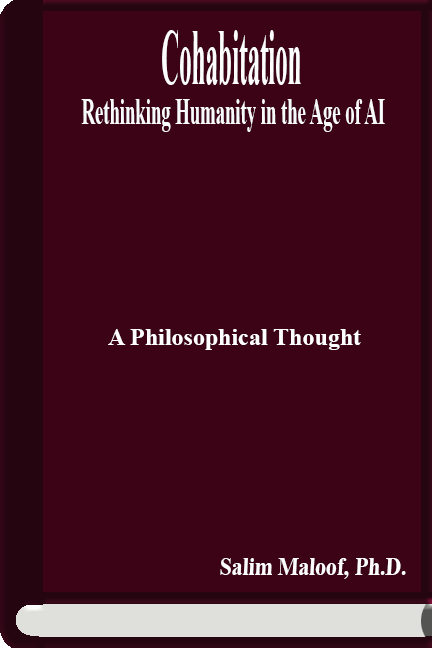
The book Cohabitation, Rethinking Humanity in the Age of AI, invites readers to question whether the philosophical teachings of Socrates, Plato, and Aristotle obstruct humanity’s grasp of ultimate truths, as other philosophers’ theories often contradicted their ideas. This decision prevented mankind from exploring alternative paths. Mankind can overcome the relativity and limitation that prevent human beings from understanding one another, leading to mankind inviting artificial intelligence to cohabit with real humans on earth, but without mankind making any progress on its aspirations to transition to an ethical system based on human reason rather than theological doctrine.
The book Cohabitation, Rethinking Humanity in the Age of AI, tries to highlight how the decision of people to let the work of other philosophers from the age of antiquity rot and not to factor adequately into the political and economic solutions that the fittest were legitimizing Heraclitus’s claim that all things are constantly in motion and change, or Parmenides’s claim about nothing moving, change being an impossibility, and that human sense perception could not be relied upon for an apprehension of truth, has prevented mankind from understanding the nature of life and, in this way, improved peace and security. So far, all the unnatural changes that people exhibit in matter and its intention appear aimed not at helping humans reach in-depth knowledge of the nature of reality and existence, but at determining who could have the weakest mind and making the fittest consider the opinions of the fittest before taking action on their own, and artificial intelligence helps to achieve this end more efficiently.
The objective of the work is to support that the systematic approach that people have been adopting since Socrates, Plato, and Aristotle introduced their sophisticated method to make choices based on deduction and inference prompted a change in human history, but without the philosophical teachings adopted, leading humans to transition to achieving practical results for the greater well-being of society fostered by substantial advances in knowledge, technology, commerce, culture, and what have you. The work will argue that, like our predecessors who relied on tools to interact with physical matter and each other, we are still doing so today, but with one key exception. The efforts that our predecessors employed made them aware of the relativity and limitations of human understanding, while current efforts may be accelerating humanity’s return to a new life cycle of existence.
You can contact Salim Maloof to request more information at Info@centerMPA.com
Disclaimer: The contents of this article are of sole responsibility of the author(s). The Center for Modernity Planning and Assessment or Salim Maloof will not be responsible for any inaccurate or incorrect statement in this article. The Center for Modernity Planning and Assessment grants permission to cross-post original articles published by the Center on internet sites as long as the text & title are not modified. The source and the author’s copyright must be displayed.