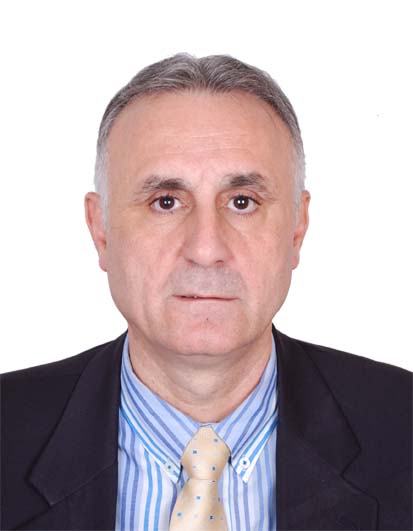
Salim Maloof: A Synopsis
Salim Maloof is the founder of the Center for Modernity Planning and Assessment and the author of the Mathematical Construct of the Global Human Security Problem, developed between 2002 and 2005. His work brings together his academic background, professional experience, and long-standing interest in understanding the relationship between human behavior, social conditions, political decision-making, and the development of societies.
Maloof was born in Lebanon, and his family immigrated to the United States at the beginning of the Lebanese civil war. He is fluent in Arabic, French, Spanish, and English and has knowledge of Russian.
In the United States, he studied at the Polytechnic Institute of Brooklyn, now part of New York University, earning a degree in chemistry and chemical engineering and subsequently a master’s degree in environmental engineering. After graduation, he worked for a U.S. engineering consulting firm designing physical, chemical, and biological processes for the control and management of biological matter.
In 1991, he returned to the Polytechnic Institute to continue his doctoral studies in environmental engineering, focusing on the control of nutrients and biological matter within biological processes. This work deepened his understanding of biological processes and contributed to his later interest in examining human beings not only as social and political actors, but also as biological entities whose behavior and interactions might be studied through a broader analytical framework.
During this period, his interests also increasingly turned toward the behavior and dynamics of physical matter, complex multidimensional nonlinear systems, and problems involving fluid dynamics and fracture. His doctoral research culminated in the dissertation Dispersion and Displacement of Non-Newtonian Fluids in Radial Flow in Porous Media.
At the same time, Maloof began to question whether the theoretical models commonly used to describe social and economic systems adequately corresponded to realities he had observed personally. His experience growing up in Lebanon and his subsequent academic studies led him to examine what he regarded as a disconnect between theoretical and experimental models and conditions observed in the social realm.
Drawing upon his background in analytical and computational methods, nonlinear dynamics, fluid behavior, and the control and management of biological processes, Maloof began developing a methodology for studying human behavior and social fracture. His objective was to explore whether concepts and methods used to understand complex physical and biological systems could contribute to a different approach to examining human and social behavior.
From the early 1990s onward, Maloof also gained extensive professional experience in international technical assistance and liaison with governments, bilateral and multilateral donors, international financial institutions, and organizations within the United Nations system. Through this work and travel in developing countries, he continued to examine the relationship between programs designed to improve social conditions and the outcomes produced through their implementation.
Between 2001 and 2003, he worked to develop a mathematical model intended to express the conclusions that had emerged from his education, professional experience, and independent research. By 2005, this work had been presented in The Global Human Security Problem: Mathematical Derivation, which set out his theory and mathematical construct in detail.
Since 2015, Maloof has devoted substantial effort to organizing and expanding his body of work through books, short books, papers, and articles. In 2017, he founded the Center for Modernity Planning and Assessment as a forum for presenting this work, inviting its examination, and offering specialized advisory, teaching, and training services connected with governance, international affairs, peace, human security, and the long-term consequences of political, economic, and social decision-making.
Between 2001 and 2003, he worked to develop a mathematical model intended to express the conclusions that had emerged from his education, professional experience, and independent research. By 2005, this work had been presented in The Global Human Security Problem: Mathematical Derivation, which set out his theory and mathematical construct in detail.
Since 2015, Maloof has devoted substantial effort to organizing and expanding his body of work through books, short books, papers, and articles. In 2017, he founded the Center for Modernity Planning and Assessment as a forum for presenting this work, inviting its examination, and offering specialized advisory, teaching, and training services connected with governance, international affairs, peace, human security, and the long-term consequences of political, economic, and social decision-making.