Posterity
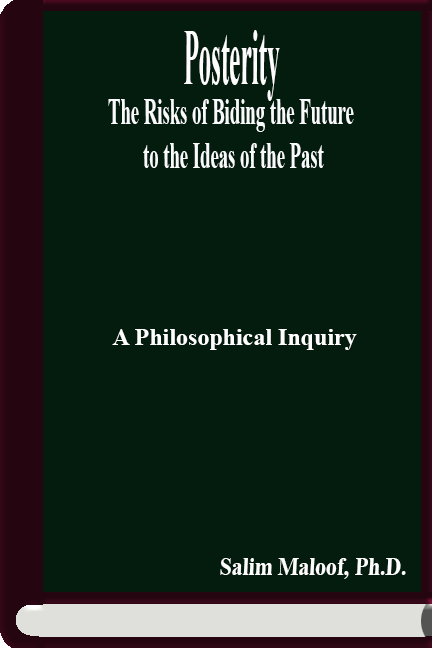
This book was written by Salim Maloof, posted on May 30, 2017
Nobody knows when people began to develop religious thought to prove the existence of God or to be concerned with man himself and how he should behave. People are being fruitful, multiplying, replenishing, subduing, and having dominion over all the living and nonliving things that move on earth, including being concerned with big questions about the universe, without giving any consideration to the ideology that, in the story of creation reported in the Old Testament of the Bible, it is acclaimed that God commanded humans to establish social order on its basis. This ideology is based on man refraining from knowing good or evil in order to live (Genesis 2:17).
People’s defiance has led them to adopt a system of thought that divides them into the categories of oppressed and oppressors. People have also divided themselves into believers and disbelievers as well. Under each opposing relationship or stance, they formulated laws, jurisprudential theories, political stances, standards, and so forth. Most importantly, those who considered their system of thought to be rooted in the idea of belief pledged to support the oppressed against the oppressor, but without upholding God’s word on earth.
In 1945, the people of the world managed to align their mindset, understanding, and awareness with the standards suggested in the UN Charter or the Universal Declaration of Human Rights (UDHR), in the hope of securing the goals, paths, and mechanisms outlined.
For various reasons, people were unable to turn the beliefs they expressed in the UN Charter or the UDHR into tangible outcomes. People persisted in their beliefs, but they struggled to convey their projects in a manner that would alter others’ perspectives, foster respect, and encourage commitment to shared plans.
Accordingly, what has been uniting people’s hearts since 1945 is technology and science. People believe that technology and science can organize their relations much better than through reliance on truth and righteousness.
All the tools people developed, including money spent to win each other’s hearts, failed to make the weakest consider the fittest’s opinion before acting, except when morality was involved. Technology and science create a leading class and a following class. Knowledge and power concentrate in the hands of the elite class. Knowledge and power can lead individuals to turn away from truth and human rights. However, while science and technology do not change reality to align with the conditions of the leading class, truth does.
The book Posterity attempts to show that human ingenuity doesn’t know how to distinguish between good or evil, contrary to what humankind believes, and that humankind continues to make the human condition a mental struggle between good and evil. This prescription will hinder humankind from reaching the ultimate goal of seeing people voluntarily or by virtue of a system of governance manage to attain an ideal state in which all nations and people exercise tolerance, a prerequisite for the maintenance of peace and stability in the world.
The book also tries to argue that people’s reunion around science and technology will fail to create the environment necessary to improve peace and security as religion did. On the contrary, the decision to leave the task of using science and technology to create an environment conducive to establishing relations based on the standards suggested in the UN Charter or the UDHR will not alter the historical dynamism that the world has experienced since antiquity; instead, it will increase division, particularly among those who pledge to uphold God’s word on earth while failing to adhere to the criteria they preach and support the oppressed against the oppressor. This is because science and technology are speculative tools and not natural tools, as morality is. Science and technology do not make people loving and committed to preserving humanity, but morality does. Morality builds steadfastness and a positive spirit.
The purpose of the book is to invite the victors of WW2 or their heirs to reflect on the danger of leaving to posterity the promotion of constant ideological and ethical agendas for the preservation of their wealth, status, and power. The book argues that as people’s awareness increases, the subsequent changes will dismantle the power of the families and dynasties that currently control the world, returning to a simpler form, while new families and dynasties will emerge to take their place.
You can contact Salim Maloof to request more information at Info@centerMPA.com
Disclaimer: The contents of this article are of sole responsibility of the author(s). The Center for Modernity Planning and Assessment or Salim Maloof will not be responsible for any inaccurate or incorrect statement in this article. The Center for Modernity Planning and Assessment grants permission to cross-post original articles published by the Center on internet sites as long as the text & title are not modified. The source and the author’s copyright must be displayed.