WW2 Without Dawn
This book was written by Salim Maloof, posted on August 15, 2025
Since the start of time, people have been trying to determine if the world of ideas comes before the material world or vice versa. People refuse to admit that their relations and conditions, specifically experiences and circumstances, could be perhaps interconnected, just like the relations and conditions of other living and non-living things with whom they co-share the world. Most importantly, people refuse to admit that the stories lived by their predecessors, as well as the events and situations unfolding in front of them, contain messages (lessons) intended to reveal insights that could provide them with an advantage over animals.
Despite this, people believe that the changes they make in reality enrich their lives far more than the lives of their predecessors, particularly because exploration enables them to achieve desired outcomes in a much easier and faster manner.
The problem is that each time people use their human ingenuity to create change (learn about the world around the human body, discover new resources, improve existence, or explore the unknown), this practice pushes the individuals involved to become more inward-looking. Additionally, the self-indulgence of the individuals involved drives them to transgress and to develop little regard for principles or what type of consequences one’s own actions could have on others. This departure from rational and prudent behavior becomes apparent, especially when people push the limits of their imaginative or ingenuous capacity, leading them to perceive that they have a divine plan. One of the most harmful effects of such a malevolent perception is that it leads people to desire reengineering their neighbors instead of focusing on transforming their own hearts or reflecting on historical lessons.
The challenge with having many people in different parts of the world letting their human ingenuity lead them into perceiving that they have a divine plan at the same time is that the goals or ideas that people begin to promote or fight for to do greater things in life induce or create bottlenecks along the way. People learned how to clear the bottlenecks (confusion, disobedience, disorder, etc.) that their ideas create, but sometimes, when people act on their ideas without pacing the changes their perceptions produce in the social order, the ensuing buildup creates widespread confusion, disobedience, or disorder worldwide. The danger of many people around the world becoming confused simultaneously is that their ideas can overpower their intrinsic values, leading them to distance themselves from reality and exploit current circumstances or opportunities solely for their own benefit or that of their group.
In the aftermath of World War Two (WW2), the victors of WW2 (the old powers) counselled their heirs (their children) to stop imagining time and space as part of reality. The old powers advised their heirs to prioritize actions that emphasize values and purpose over individualism. The old powers wanted to prevent their children (their heirs) from creating a world of appearance because its aspect easily pushes people to leave them (their heirs) or deny them more power than others, thus threatening the rejuvenation of their power.
For various reasons, the heirs of the old powers chose to disregard their fathers’ counsel, which aimed to ensure that a collective, self-conscious force drives history and culture. Instead, they opted to allow the personal power and conscience of their critical thinkers and servants (governments and international institutions) to drive this process, utilizing the work program suggested in the UN Charter and the UDHR in the aftermath of WW2.
The idiom “cart before the horse” warns against doing things contrary to the way certain actions are normally best done. The decision of the heirs of the old powers to let the personal power and conscience of their critical thinkers and servants (governments and international institutions) serve as a tool to rejuvenate their power, wealth, and status as compared to (or before) letting the lessons that their fathers gained from their stories and experiences guide this process has not controlled the class struggle that existed before WW2 erupted and whose development led to this global war but is encouraging people to withdraw their obligation to obey them more. In fact, the decision of the heirs of the old powers to invest in the same ideas that their fathers employed to rejuvenate their power, wealth, and status before WW2 erupted could be the most naive act that they have committed since 1945 or after their fathers dismantled their empires. This is because when those powerful families/dynasties (the heirs of the old powers) become impatient and refuse to wait until the generation that they exhausted its members with endless conflicts lapses or has rest before subjecting its successors to the same tyranny and oppression, it becomes impossible to make the children of the people that they abused their fathers want to consider their opinion before taking action of their own to arrive at doing it, without putting into question their intention first. Only a break in tyranny and oppression permits a new generation that knows nothing about the way its fathers were abused to accept being a victim of the idea of good (democracy, social justice, freedom, etc.) that the fittest usually use to divide and rule others through their mechanisms.
Throughout history, whenever dialectical processes were used to develop parameters for everyday behavior, but without this process factoring in the effect of energy, frequency, and vibration in the ordered relations that were being sought, the synthesis that resulted resembled the same beautiful geometric patterns that one obtains when one scatters sand on vibrating plates. The more sand a person adds to a vibrating plate, the more complex the geometric patterns that result become
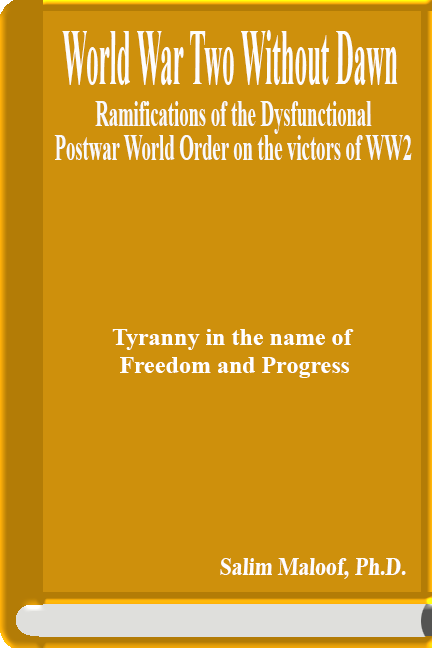
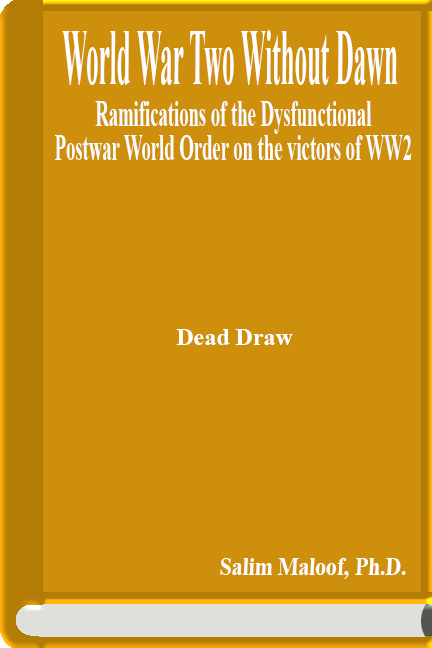
The book World War Two Without Dawn examines how the heirs of the old powers’ decision to reject collaboration, prioritize their fathers’ work program in the UN Charter and UDHR, and pursue a different conception to rejuvenate their power might prevent them from writing a different world history than their fathers wrote. The book tries to show how the ego of the heirs of the old powers could be moving people to a sphere of mental activity that is least sensitive to what is needed for them to keep their dominant role. The book tries to show how the resulting synthesis requires the heirs of the old powers to develop a new thesis, whose subjective and objective aspects prevent them from slowing people’s emotions while, at the same time, causing people to become removed from the depths of their personalities. Accordingly, the more the forces that would be acting on the animalistic behavior of people serve as drivers to create change, the more the transformations that would be happening would be reciprocally disintegrating the power, wealth, and status of the heirs of the old families/dynasties so new families/dynasties start to play their role.
The objective of the book is to call the attention of the heirs of the old powers to the risks that they could be piling up and subjecting their power, wealth, and status to confrontation if they continue to assault the truth and let their critical thinkers and servants (governments and international institutions) regard themselves as exempt from observing the appeal suggested in the UN Charter or the UDHR in a world whose members are obsessed with themselves and their self-improvement and self-empowerment over collective actions.
___________________________________________________________________
You can contact Salim Maloof to request more information at Info@centerMPA.com
Disclaimer: The contents of this article are of sole responsibility of the author(s). The Center for Modernity Planning and Assessment or Salim Maloof will not be responsible for any inaccurate or incorrect statement in this article. The Center for Modernity Planning and Assessment grants permission to cross-post original articles published by the Center on internet sites as long as the text & title are not modified. The source and the author’s copyright must be displayed.