The Prison
This book was written by Salim Maloof, posted on July 05, 2018
In 1941, the United States and Great Britain proposed to engineer a postwar world if they were to win the Second World War, which would have achieved for mankind what religion failed to accomplish since man began to believe in the existence of superpowers. Those two countries, with the existing nations that bought into the idea, proposed to create an international intergovernmental organization to coordinate this project. This organization was founded in 1945 and was named the United Nations.
The original founding fathers of the United Nations did not counsel that this association of nations offer economic, political, and social solutions but rather coordinate the actions of UN member states. This job of determining the economic, political, and social status of UN member states was reserved to respective governments.
Post the founding of the United Nations, the UN member states expanded the activities of the United Nations. The UN member states created UN subsidiary organs and gave them the right to take joint and separate action in cooperation with respective governments for the achievement of the ends set forth in the UN Charter.
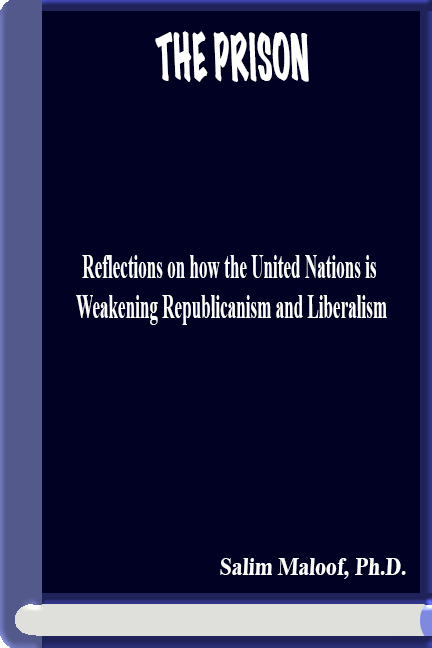
“The Prison: Reflections on how the United Nations is weakening Republicanism and Liberalism”is a book written to emphasize how the new post-war world governance system that the nations with great and soft powers mounted in the aftermath of WW2 could be an arrangement that resembles the governance that is employed in a prison system. The work depicts how independent nations can serve as a representative model for the way inmates are incarcerated in prison cells. The international families of financiers are the ones who administer the new postwar international system (or prison); the prison guards are the five permanent members of the UN Security Council, and the United Nations is the entity that is running the prison common services.
The book tries to show how the international intergovernmental organization named the United Nations is toppling the work of the UN member states to ultimately make every member of the human family enjoy freedom from fear and want by showing how this organization is involved in violating the UN Charter and the Universal Declaration of Human Rights, consequent to the decision of the UN member states of making the UN become an economic operator.
Jesus entered a temple once and found that the people had converted this house of prayers into a market.
“The Prison: Reflections on how the United Nations is weakening Republicanism and Liberalism” is a book that shows how the UN has converted into becoming a market after the UN member states approved the UN creating a UN subsidiary organization to help them with providing solutions to international economic, social, health, and related problems using staff who are performing their duties while enjoying diplomatic privileges and immunities.
Could Christianity, Buddhism, Hinduism, Islam, Judaism, and all other known religions survive if their clergy taught the word of God while also pursuing the full development of their personalities and dedicating themselves to serving all living beings?
The book, “The Prison: Reflections on how the United Nations is weakening Republicanism and Liberalism,” invites the US government and other UN member states to consider whether the UN can create the necessary conditions for stability and well-being that foster peaceful and friendly relations among nations, based on respect for the principles of equal rights and self-determination, while it provides solutions to member states through self-financed organizations that may undermine their ability to defend their interests in practicing republicanism and liberalism..
The objective of the book is to argue that UN member states should suspend the various UN development organizations from maintaining relationships with the UN in order to prevent further crises and disorder for humanity.
You can contact Salim Maloof to request more information at Info@centerMPA.com
Disclaimer: The contents of this article are of sole responsibility of the author(s). The Center for Modernity Planning and Assessment or Salim Maloof will not be responsible for any inaccurate or incorrect statement in this article. The Center for Modernity Planning and Assessment grants permission to cross-post original articles published by the Center on internet sites as long as the text & title are not modified. The source and the author’s copyright must be displayed.